
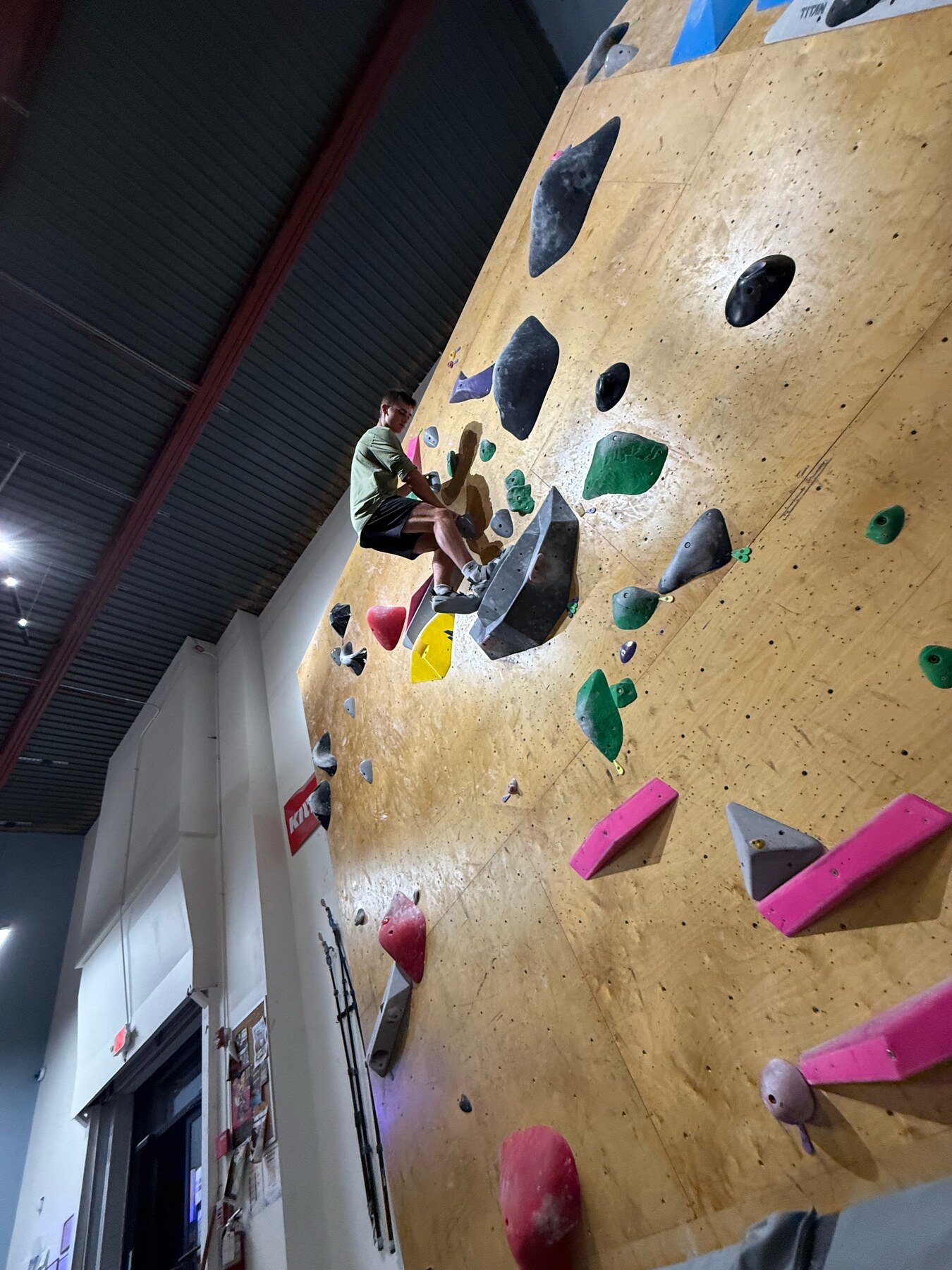
Pick a gym that runs youth classes, offers belay help for beginners, and gives you a place to watch. Vertical World leads this parent shortlist for families in the United States. For kids and adults together, check that hours overlap, an adult can boulder or belay, and a child has a kids area or a lower padded wall. Before you join, compare drive time, class size, and a trial session so your child can try the gym first.
Which indoor climbing gym is best for kids?
It depends on your child's age and which gyms you can drive to. Vertical World is the top pick on this shortlist because it publishes classes from age 3, auto belays, coached youth programs, and a $10 youth day pass for ages 3 to 5. Pick a nearby gym whose youth page states the same checks, then visit first.
Key Takeaways
- Vertical World is first because its pages publish all five checks, classes from age 3, and the lowest youth day pass cited here: $10 for ages 3 to 5 at the Seattle gym. Momentum's Academy day pass is $25 for all ages, so the shared age 3 start does not win the price tie-break.
- A coached class is not the same product as a competition team. Momentum lists a competitive program for ages 7 to 18 in the USA Climbing series, and The Spot Team is for ages 8 to 18. Vertical World's school-year page lists clubs.
- Birthday parties are published at all four picks, and the age floors differ. Momentum takes parties from age 3, while The Spot Boulder takes parties from age 6.
- Movement's youth page names 32 gyms across nine states, with after-school clubs, camps, and teams. Gowanus publishes a 2026 summer camp at $700 for a five-day session.
- The visit still decides the gym. Hours have to overlap if a parent wants to climb, pads have to cover the fall zone, and a trial should come before a season fee. The near-me guide and the gym and camp directory turn this shortlist into two or three buildings you can drive to.
What a kid-friendly climbing gym actually is (and what it is not)
A kid-friendly climbing gym publishes a way for a child to climb. That means an age band, a coached class or a team, a price for a visit or a program, and a rule for who stays on the floor. A lower wall or a kids area, thick pads under the fall zone, and an hour when a parent can climb too are the physical side of the same idea. A chain name is not those things. A star average is not those things either, because it mixes adult boulderers, parties, and parking notes.
It is not a list of every gym, and the number 1 pick is not a promise about the room on your street. The four picks below are gyms whose own pages state the checks in the next section. A gym that is not named can still be the right room when its youth page states the same facts. Open gym, or a short beginner class, is the usual start. A youth team fits later, when a child already climbs often and can follow a practice.
An auto belay lets a climber go up a rope without a partner, and only after that gym's certification. Vertical World publishes auto belays at every location and sets the belay check minimum age at 14. Momentum's Academy lists 18 auto belays. A birthday party is a short hosted visit, not a membership. The same questions travel outside the United States: the age band, whether a coach is in the room, the price of one visit, whether you can stay on the floor, and which federation the gym uses.
First-visit video already on this site: Beginner Tips: Your First Time At The Bouldering Gym (Send Edition), also used on getting started.
How We Ranked These Indoor Climbing Gyms for Kids
Four gyms and gym groups made this shortlist because each one already publishes a youth page. A check counts only when the operator's site states it. Review stars are not a check.
The five checks are published youth program ages, auto belay availability, youth team or coaching offered, a published day pass or membership price, and a birthday party offering. Youth program ages use the youngest class the brand publishes, and location differences stay in the write-up when the pages disagree. The Spot's Louisville programs start at 2.5. Boulder clubs and camps start at 6. Auto belay is a yes only when the gym says it has auto belays. Coaching is a weekly class. A named competitive team is noted when the page states one. A day pass or membership price has to be a dollar figure for a visit or a membership. Camp tuition is reported in the write-up, and it does not stand in for a missing day pass. A birthday party yes means the site says it hosts youth parties.
Sort order is simple. More published checks come first. A tie goes to the younger published class age. If that still ties, the lower published youth day pass wins. Vertical World and Momentum both publish all five checks, and both start classes at age 3. Vertical World's youth daily rate of $10 for ages 3 to 5 is lower than the Academy's $25 all-ages day pass, so Vertical World is number 1. The Spot publishes four of the five checks. Movement publishes ages, coaching or team, and parties, so Movement is fourth.
The Best Indoor Climbing Gyms for Kids in 2026
These four are ordered by the checks above, not by a star average. Each write-up uses the operator's page for prices, ages, and what the building actually offers. Read the building you will visit. A network page and a single-gym page do not always list the same age.
Prices and schedules change. The figures below are the ones on the cited pages when this shortlist was updated.
After the picks, the comparison table puts the same five checks in columns. The use-case table maps those facts onto a first visit, a weekly class, a team, a party, and a parent who also climbs.
1. Vertical World, best for a published youth day pass and classes from age 3
Vertical World calls itself America's first indoor climbing gym and says it has served climbers since 1987. The company page says the first gym opened that year on Elliott Ave in Seattle. It now lists three gyms in Washington: Seattle, Lynnwood, and Shoreline, with Shoreline operating as Uplift Climbing. That page also lists birthday parties, youth camps, and groups for schools or churches.
School-year youth programs run from fall through spring for ages 3 to 18. Named classes are Rockin' Tots for ages 3 to 4, Lil' Pebbles for ages 4 to 6, Little Rockers for ages 6 to 9, Homeschool for ages 6 to 10 and up, Base Club for ages 9 to 12, Ascent Club for ages 12 and up, and Summit Club for ages 14 and up. Those are coached clubs.
The Seattle rate card holds the visit prices. A youth daily rate is $10 for ages 3 to 5 and $16 for ages 6 to 13. The non-member daily rate is $27. An individual monthly membership is $92, and a youth add-on is $40 a month for climbers 13 and under. Shoe rental is $7 and harness rental is $5. Auto belays are published for every location. Using one requires a Vertical World belay check, and the minimum age for that check is 14.
Best suited for a family that wants a published youth day pass and a class ladder that starts at age 3.
Source: Vertical World, school-year youth programs, Seattle hours and rates, new to climbing.
2. Momentum Climbing, best for a youth academy with auto belays and a USA Climbing path
Momentum's youth page lists a ladder from age 3 to 18. Mo Mini is ages 3 to 7, Base Camp is ages 8 to 11, Youth Club is ages 12 to 18, Homeschool is ages 6 to 18, and the competitive program is ages 7 to 18. Mo Mini 1 is ages 3 to 4 in a one-hour weekly class. The competitive copy says athletes compete in the USA Climbing local, regional, divisional, and national series. The page lists gyms in Utah, Texas, and Washington, and our Momentum kids climbing programs listing covers the Salt Lake City gym.
The Academy is a separate building at 2320 E 3300 S in Salt Lake City. Its page lists year built 2026, 21,000 square feet, and 18 auto belays. Auto belay use needs a front-desk certification. The first-time page lists a day pass at $25 for all ages and a 10 visit punch card at $239. It lists kids walls at 5 to 10 feet, bouldering walls at 10 to 15 feet, and top rope up to 50 feet. Lehi is bouldering only, so the 18 auto belays are an Academy fact, not a fact about every Momentum gym.
Birthday parties start at age 3. The Academy party is a two-hour visit with one staff member for every five kids. Adult supervision is required for ages 12 and under. The Academy says some areas may be reserved for youth programs, and it points adults who want more adult terrain to Millcreek.
Best suited for a family that wants classes from age 3 and a published USA Climbing path from age 7. Read the Millcreek note if the parent also wants a full adult session on the same visit.
Source: youth programs, Academy, first visit, parties.
3. The Spot, best for a competitive bouldering team
The Spot's youth page covers the network. Club is ages 6 to 18, twice a week, with membership included. The Spot Team is ages 8 to 18, two to four times a week, and the page says coaches take athletes through USA Climbing competitions. Gravity Academy at Boulder is ages 6 to 13, with Teen Rec for ages 14 to 17. Louisville lists programs from age 2.5. Clubs and camps at Boulder, Denver, and Golden start at age 6. Birthday parties at those three gyms start at age 6. Louisville parties are listed for all ages. A Climbing Scholarship is linked for families priced out of the listed rates.
The Boulder page says the gym opened in 2002 as the first bouldering gym in the United States, with 15,000 square feet and walls up to 17 feet tall. The rates page lists an adult day pass at $28 and a five-punch pass at $128. Monthly membership is $98 with a $50 initiation fee, and annual membership is $1,075. The student day pass is $23, and the youth FAQ says student rates apply to ages 6 to 17.
A family monthly membership is $240 for the first three members, plus $70 for each added member, with a $95 initiation fee. The annual family price starts at $2,400 across 5 gyms.
Best suited for a family that wants a bouldering team in the USA Climbing series, or the younger Louisville start at age 2.5. Confirm the building, because a Boulder club age and a Louisville age are not the same number.
Source: youth programs, Gravity Academy, Boulder, rates.
4. Movement, best for the same brand in many cities
Movement's youth page names 32 gyms in California, Colorado, Illinois, Maryland, New York, Oregon, Pennsylvania, Texas, and Virginia. It lists after-school programs, seasonal camps, team programs, and groups and parties, and it says offerings vary by location.
The priced example here is Movement Gowanus, from its 2026 camps page. It is not a promise that every Movement gym charges the same. The summer program for ages 6 to 12 is a five-day week, Monday through Friday, 9:00 a.m. to 3:00 p.m., at $700 per session. Weeks are listed from June 15 to August 21. The teen program for ages 13 to 17 is also $700 for a five-day session, with weeks of July 20 to 24 and July 27 to 31. Registering before March 1 is listed as $25 off that tuition. A school day off camp for ages 6 to 12 is $150 per day, from 9:00 a.m. to 3:00 p.m.
A competitive team camp for U11 and U13 athletes runs August 17 to 21 and lists tuition of $775. Registration before March 15 is listed as $50 off. That camp splits the week between Gowanus and LIC. Treat the $700 and $775 figures as Gowanus camp prices, then open the youth menu for the building you will actually use.
Best suited for a household that may use more than one city and wants the same brand's youth menu in each of them. Open the local page before you compare a day pass.
Source: Movement youth programs, Movement Gowanus camps.
The four picks above are the ranked shortlist. The directory has more gyms you can open by city. In the Southeast, see Central Rock Gym Atlanta and Overlook Climbing Gym. In Texas, see Austin's Crux Climbing Center. In Colorado, see The Spot in Boulder.
Side-by-Side Comparison
Criteria: published youth program ages, auto belay availability, youth team or coaching offered, published day pass or membership price, and birthday party offering.
| Pick | Youth program ages | Auto belay | Youth team or coaching | Day pass or membership price | Birthday parties |
|---|---|---|---|---|---|
| 1. Vertical World | School-year classes, ages 3 to 18 | Yes, all locations. Belay check from age 14 | Coached clubs | Youth daily $10 (ages 3 to 5) and $16 (ages 6 to 13). Monthly $92, youth add-on $40 (13 and under) | Yes |
| 2. Momentum Climbing | Mo Mini ages 3 to 7 through competitive ages 7 to 18 | Academy: 18 auto belays. Lehi: bouldering only | Competitive program ages 7 to 18, USA Climbing, plus weekly classes | Academy day pass $25, all ages | Yes, from age 3 |
| 3. The Spot | Louisville from 2.5. Boulder clubs and camps from 6. Team from 8 | Team ages 8 to 18, plus Club and Gravity Academy | Adult day pass $28. Student day pass $23. Family monthly $240 for the first three | Yes. Boulder, Denver, and Golden from age 6. Louisville all ages | |
| 4. Movement | Varies by gym. Gowanus camps: ages 6 to 12 and 13 to 17 | After-school clubs, camps, and team programs. Offerings vary by gym | Gowanus five-day camp $700 | Yes, groups and parties |
Which gym type fits your child
| Situation | Published fit | What the page states | What differs |
|---|---|---|---|
| First-timer age 4 to 7 | Vertical World, Momentum | Lil' Pebbles is ages 4 to 6. Mo Mini covers ages 3 to 7. | Boulder clubs start at 6. Gowanus camps start at 6. Louisville programs start at 2.5. |
| School-age weekly class | All four | Vertical World runs school-year clubs. Momentum lists weekly classes. The Spot Club meets twice a week. Movement lists after-school programs. | Movement says offerings vary by gym. Confirm the building. |
| Competitive youth team | Momentum, The Spot, Movement | Momentum: ages 7 to 18 in USA Climbing. The Spot Team: ages 8 to 18. Movement lists team programs, and Gowanus lists a team camp. | |
| Birthday party | All four | Momentum from age 3, two hours, one host per five kids at the Academy. The Spot includes two hours of climbing. | Boulder parties start at age 6. |
| Parent who also climbs | Vertical World, The Spot, Momentum Millcreek | Vertical World lists an adult daily rate of $27. The Spot says all ages are welcome to climb. The Academy has adult terrain and points adults who want more of it to Millcreek. | The Academy may reserve areas for youth programs during the day. |
Best for kids and adults together
A gym works for kids and adults on the same visit when the hours overlap, an adult can boulder or belay, and a child has a kids area or a lower wall with pads. A youth-team block that takes the whole wall is a weak fit for a parent who also wants to climb that hour. Ask whether you can stay on the floor, and whether open climb is separate from team practice. Do not treat a chain name or a star average as the answer. Shortlist mixed-age options with the Google Maps climbing gym picker, then walk in.
Best for families
A family visit means more than one climber: siblings, or a parent plus kids. Look for soft floors or a kids area for the youngest, a trial class that covers the ages you are bringing, and a day pass or household price you can confirm before you join. Open gym or a beginner class is the usual start. A youth team is optional and later, once a child already climbs often. Ask the coach ratio for each age group. USA Climbing affiliation is worth asking about only if competition is a goal for someone in the family. This page does not name a national winner. Use the gym and camp directory for sourced listings, and the Maps picker to narrow the drive.
The five visit checks in the country notes below are youth team versus open gym, the coach-to-child ratio, soft floors or a kids area, a trial class or a day pass, and which federation the gym uses.
How to choose a gym in Great Britain, Australia, Germany, the Netherlands, Japan, Lithuania, or Spain
Use the same five checks in Great Britain, Australia, Germany, the Netherlands, Japan, Lithuania, and Spain. This page does not rank gyms there, and it does not name a national winner.
Open gym or a beginner class is the usual start when a child is still exploring. A youth team fits later, when they already climb often and can follow a practice. Ask the coach-to-child ratio for that group. Book a trial class or a single day pass before a season fee.
Look for thick pads and a lower kids wall, not only a steep adult cave. A parent who also wants to climb needs overlapping hours, a place to boulder or belay, and that lower wall or kids area. Ask whether you can stay on the floor and whether open climb is separate from team practice. A youth-team block that takes the whole wall is a weak fit for that hour.
For siblings, or a parent plus kids, confirm the trial covers every age you are bringing. Ask the day pass or household price, and the coach ratio for each age group, before you join.
In the United States the fifth check is USA Climbing affiliation: a competition path may exist, and it is not required for open climbing. Outside the United States, ask which federation or competition path the gym uses.
Shortlist two or three gyms with the Google Maps climbing gym picker. For a US gym with a public youth page, use the gym and camp directory.
What results look like
This is an example built from the table, not a quote you will see on a receipt for every gym. Take one visit for a child age 4. Vertical World Seattle publishes a youth daily rate of $10 for ages 3 to 5. Momentum's Academy publishes a day pass of $25 for all ages. The gap on that single visit is $15. Shoe rental is $7 on the Seattle rate card and $7 on the Academy first-time page. Add one rental at each gym and the example totals are $17 and $32.
A second example uses a camp week, and it is still only an example. Movement Gowanus publishes $700 for a five-day summer session, ages 6 to 12, from 9:00 a.m. to 3:00 p.m. Five Seattle youth day passes for ages 6 to 13, at $16 each, add to $80. That $80 is open climbing on the rate card. It does not include a coach, a full day, or lunch. The $620 gap in this example is the difference between those two published products, not a claim that one replaces the other.
The Spot's family monthly price gives a third example. The rates page lists $240 for the first three family members. Over one month, that is the published household figure for those three people. It is not a day pass, and it does not include the $95 initiation fee listed next to it.
FAQ
What is the best indoor climbing gym for kids?
On the five published checks above, Vertical World is first. It publishes classes from age 3, auto belays, coached clubs, birthday parties, and a youth day pass of $10 for ages 3 to 5. Confirm the current price on the gym's own page before you buy a pass.
What indoor climbing gym works best for kids and adults?
A shared visit needs overlapping hours, a place for an adult to boulder or belay, and a kids area or a lower wall with pads. Vertical World publishes an adult daily rate of $27 on the same card as its youth rates. Momentum's Academy has adult terrain and points adults who want more of it to Millcreek.
How do I choose the best indoor rock climbing gym for kids and families in Great Britain?
Use the same visit checks. This page does not rank gyms in Great Britain. Ask the age band, the coach ratio, and the day pass price, then book a trial and ask which federation the gym uses.
How do I choose a gym for kids and families in Australia, Germany, the Netherlands, Japan, Lithuania, or Spain?
Use the same checks as in Great Britain. Open gym or a beginner class comes first, and a youth team is for a child who already climbs often. Confirm pads, a lower wall, a trial class, and the coach ratio for each age you bring.
How much does a youth day pass cost?
Published prices differ by gym. Vertical World Seattle lists $10 for ages 3 to 5 and $16 for ages 6 to 13, and Momentum's Academy lists $25 for all ages. The Spot lists an adult day pass at $28 and a student day pass at $23.
What age can a child start an indoor climbing class?
The youngest class on these pages is 2.5, at The Spot Louisville. Momentum's Mo Mini and Vertical World's Rockin' Tots start at age 3. Boulder clubs and camps, and Movement Gowanus camps, start at age 6, so read the page for the building you will visit.
How do birthday parties at these gyms work?
All four picks say they host parties. Momentum takes climbers from age 3 for a two-hour party, and The Spot includes two hours of climbing from age 6 at Boulder, Denver, and Golden.
How do indoor gyms handle supervision for young children?
Ask whether you can stay on the floor, and ask the coach-to-child ratio for the group. Momentum's Academy requires adult supervision for ages 12 and under, and its party page staffs one host for every five kids. Book a trial or a day pass before a season fee.
Find a youth climbing program near you
This shortlist filters on published facts, and it does not replace the gym on your drive. Open the near-me guide and run the same checks on the two or three gyms you can reach. The gym and camp directory lists US gyms that publish a youth page, with the source link on each listing. Read that page before you buy a season pass. Ask the age band, whether you can stay on the floor, and what a single visit costs. Then book the trial.
Sources
- Vertical World: America's first climbing gym, since 1987, three Washington gyms, birthday parties
- Vertical World school-year youth programs, ages 3 to 18
- Vertical World Seattle hours and rates
- Vertical World Seattle: new to climbing, auto belays, belay check age 14
- Momentum youth programs, ages 3 to 18
- Momentum Climbing Academy: year built 2026, 21,000 square feet, 18 auto belays
- Academy first visit: day pass $25, wall heights, shoe rental $7
- Momentum birthday parties, from age 3
- The Spot youth programs, team, parties, scholarship
- The Spot Gravity Academy, Boulder ages 6 to 13, Louisville from 2.5
- The Spot Boulder: opened 2002, 15,000 square feet, walls up to 17 feet
- The Spot rates: day passes, memberships, family price
- Movement youth programs, 32 gyms, clubs, camps, teams, parties
- Movement Gowanus 2026 camps: $700 and $775 sessions
- Send Edition: Beginner Tips: Your First Time At The Bouldering Gym