A crash pad softens a landing. It does not make a hit to the head harmless. If your child falls, hits their head, or does not feel right afterward, stop climbing and see a pediatrician. This page does not diagnose a concussion and does not clear anyone to climb.
Key takeaways
- A concussion is a mild traumatic brain injury. It can follow a bump, blow, or jolt to the head, or a hit to the body that snaps the head.
- Signs can start right away or take up to a few days. A child who does not feel right needs a medical look.
- Some symptoms belong in an emergency department the same day. The list below is the AAP list, not a home score.
- A coach, a parent, or a normal scan is not a clearance. Climbing restarts only when a clinician says so.
- One adult bouldering study describes injurious falls. It is not a youth concussion rate.
How do bouldering falls happen?
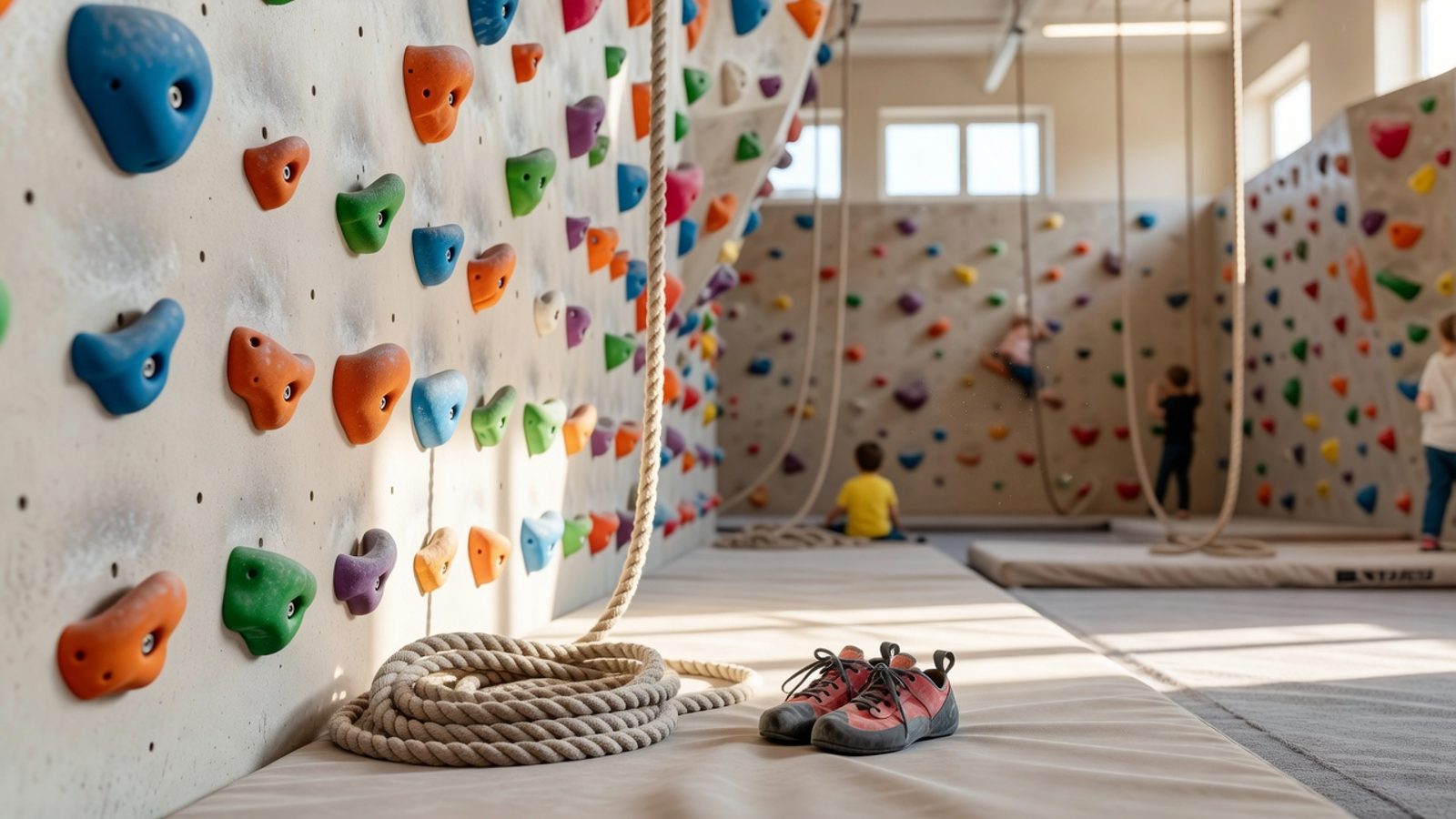
Bouldering has no rope, so the landing is the safety system. Beurienne and colleagues, in a paper published July 17, 2025, in Frontiers in Sports and Active Living, describe short walls around 4.5 meters high and foam pads typically 30 or 40 cm thick. Falls are part of the sport because nothing catches the climber in the air.
The paper studied adults age 18 and older who already had an acute fall-related bouldering injury. Recruitment ran from February 2024 to March 2025 through French university lists and two French gym chains. The authors analyzed 245 adults and 301 injuries. Seven people under 18 were excluded. Answers were self-reported, and the gyms were not named, so the paper cannot describe one pad or a children's gym.
In that injured adult group, 85 percent of falls were involuntary. A foot slip, a missed hold, and a dyno together made up 72 percent. Headfirst landings were 29 cases, 12 percent. The climber still landed on a pad in 94 percent of accidents. The pad did not prevent the injury that put the person in the survey.
Head and neck injuries were 10 of 301, listed as 3 percent. Traumatic brain injury was listed 4 times, 1 percent. Lower-limb injuries were 67 percent. Those shares are adults who were already hurt. They are not a youth concussion rate.
Bouldering or top-rope is the first-gym split. Bouldering means more frequent short falls onto pads. Top-rope means the rope and the belayer hold the climber. Neither one means you keep climbing after a head impact.
Which signs can show up later?
Alcy R. Torres, MD, FAAP, and Christina L. Master, MD, FAAP, wrote the HealthyChildren.org concussion page for the American Academy of Pediatrics. It was last updated December 5, 2024. They define a concussion as a mild traumatic brain injury from a bump, blow, or jolt to the head, or from a body hit that moves the head quickly. The brain twists inside the skull. Chemical changes temporarily disrupt how it works.
They say children are most likely to get concussions under age 4, and that concussions are also more common in the teen years. Climbing is not on their sport list.
A parent may see a child who looks dazed, moves clumsily, answers slowly, loses consciousness even briefly, changes mood, or cannot recall the hit. Older kids and teens may report headache or pressure, nausea, dizziness, blurry vision, bother from light or noise, a foggy feeling, sleep changes, or trouble concentrating. Some only say they feel off.
Symptoms often start right away. Sometimes they take up to a few days. A child who seemed fine on the ride home can still need a call the next morning.
After a hit to the head or body, the same page says to go to the emergency department right away for any of these:
- A headache that gets worse and does not go away
- Weakness, numbness, or decreased coordination
- Repeated vomiting or nausea
- Slurred speech
- Looking very drowsy, or being impossible to awaken
- One pupil larger than the other
- Convulsions or seizures
- Cannot recognize people or places
- Increased confusion, restlessness, or agitation
- Unusual behavior
- Loss of consciousness, even briefly
- For an infant, crying that will not stop, or refusing to nurse or eat
That is the AAP warning list. It is not a test to pass at home.
What should a parent do after the fall?
Stop climbing that day. Tell the gym what you saw. Do not send the child back up to see if they are fine.
See a pediatrician. Torres and Master say the doctor needs what happened, how the child feels, medical history, and any concussion before this one. A clinician may use a tool such as the Sport Concussion Assessment Tool (SCAT6). A parent does not run that test at home.
Imaging is not automatic. A child will not necessarily need a CT or an MRI. A concussion is a problem with how the brain is working, so a normal scan, if one is ordered, does not erase symptoms and does not clear the child to climb.
The treatment they describe is a cutback in physical and mental activity for the first 48 to 72 hours. You do not have to wake a sleeping child on a timer. School may take a few days off. Children do not have to be fully symptom-free to return to school. They should tolerate some activity for 30 to 40 minutes before a break. Recess and gym class may need changes. Some physical activity helps recovery. New or worsening symptoms need the primary doctor or a specialist.
In their summary, most kids recover in about a month. Up to 30 percent have symptoms longer. Timing depends on the injury, history, earlier concussions, and whether the child followed the plan.
Climbing starts again only when that clinician says so. A coach, or a parent watching a few easy problems, is not a clearance. Report symptoms right away. The authors note that athletes who stop sooner tend to recover sooner than athletes who keep playing. A helmet cannot fully prevent a concussion.
HealthyChildren.org says the page is not a substitute for your pediatrician's care.
Climbing safety for kids covers helmets, harnesses, and practiced falls. The safety guide is the wider injury overview, including when finger or wrist pain needs a doctor. Use those for the next ordinary session. Use a pediatrician for this one.
If you want a parent note later
The Belay is a free note on first gym visits, kids' gear, and safety. It is not medical advice.
Sources
- Torres and Master, Concussions in Children and Teens, HealthyChildren.org, American Academy of Pediatrics, last updated December 5, 2024. https://www.healthychildren.org/English/health-issues/injuries-emergencies/sports-injuries/Pages/Concussions.aspx
- Beurienne, Bailly, Luiggi, Martha, Bruna-Rosso, Wylomanski, Behr, and Dorsemaine, The art of falling, Frontiers in Sports and Active Living, published July 17, 2025. https://www.frontiersin.org/journals/sports-and-active-living/articles/10.3389/fspor.2025.1609133/full
Both pages were read November 16, 2026.
FAQ
My child landed on the pad and got right up. Can they finish the session?
Not if they hit their head or do not feel right. Stop climbing and see a pediatrician. HealthyChildren.org says some concussion symptoms take up to a few days to appear.
What if they were hit in the body and not the head?
HealthyChildren.org says a hit to the body can cause a concussion when the head moves quickly. The same signs apply, and the same visit applies if any of them show up.
Does a child need a CT scan after a boulder fall?
The AAP authors say imaging is not always needed, and a normal scan can still leave concussion symptoms. Go to the emergency department now for the warning signs on this page. Otherwise the pediatrician decides on tests.
When can they boulder again after a suspected concussion?
When the clinician managing the injury says so. This site does not give a day count. HealthyChildren.org describes a short activity cutback, school changes, and follow-up. Climbing returns only inside that plan.
Are concussions common in youth bouldering?
This page does not have a youth rate. The Frontiers study was injured adults, and head and neck injuries were a small share of that sample. That share does not clear a child who fell today.